

Short answer: To choose a personal trainer in Calgary, check five things: a recognized certification (CSEP, NSCA, ACSM) or a Professional Kinesiologist designation, experience with people like you, a proper first assessment, a written plan, and clear pricing. Expect to pay about $70 to $130 a session for one-on-one training in Calgary.
I’m Nathaniel Ernst, a Professional Kinesiologist (PKin) with the Alberta Kinesiology Association, and I run NATEFIT, a private personal training studio in southeast Calgary. A lot of our clients look for us because they want a more personalized approach. Most of them are nervous at first simply because they don’t know what to expect, so we try to lay it all out up front.
This guide covers what to look for when you choose a personal trainer, the questions to ask before you pay, and the red flags that mean you should keep looking.
In this guide:
- Why it’s hard to choose a personal trainer in Calgary
- Which credentials should a personal trainer in Calgary have?
- How to choose a personal trainer: 7 checks
- Questions to ask before you choose a personal trainer
- Red flags when choosing a personal trainer
- Personal trainer vs kinesiologist: which one do you need?
- How much should a personal trainer cost in Calgary?
- How to choose a personal trainer who fits your goal
- Frequently asked questions
- Book a consultation
Why it’s hard to choose a personal trainer in Calgary
Anyone in Alberta can call themselves a personal trainer. The title isn’t regulated, so there’s no provincial licence and no public register to check. Some trainers have a university degree and years of experience; others did a weekend online course.
That’s why it pays to choose a personal trainer on evidence, not on a gym’s sales pitch or an Instagram feed. The checks below take about 15 minutes, and most good trainers will be glad you asked.
Which credentials should a personal trainer in Calgary have?
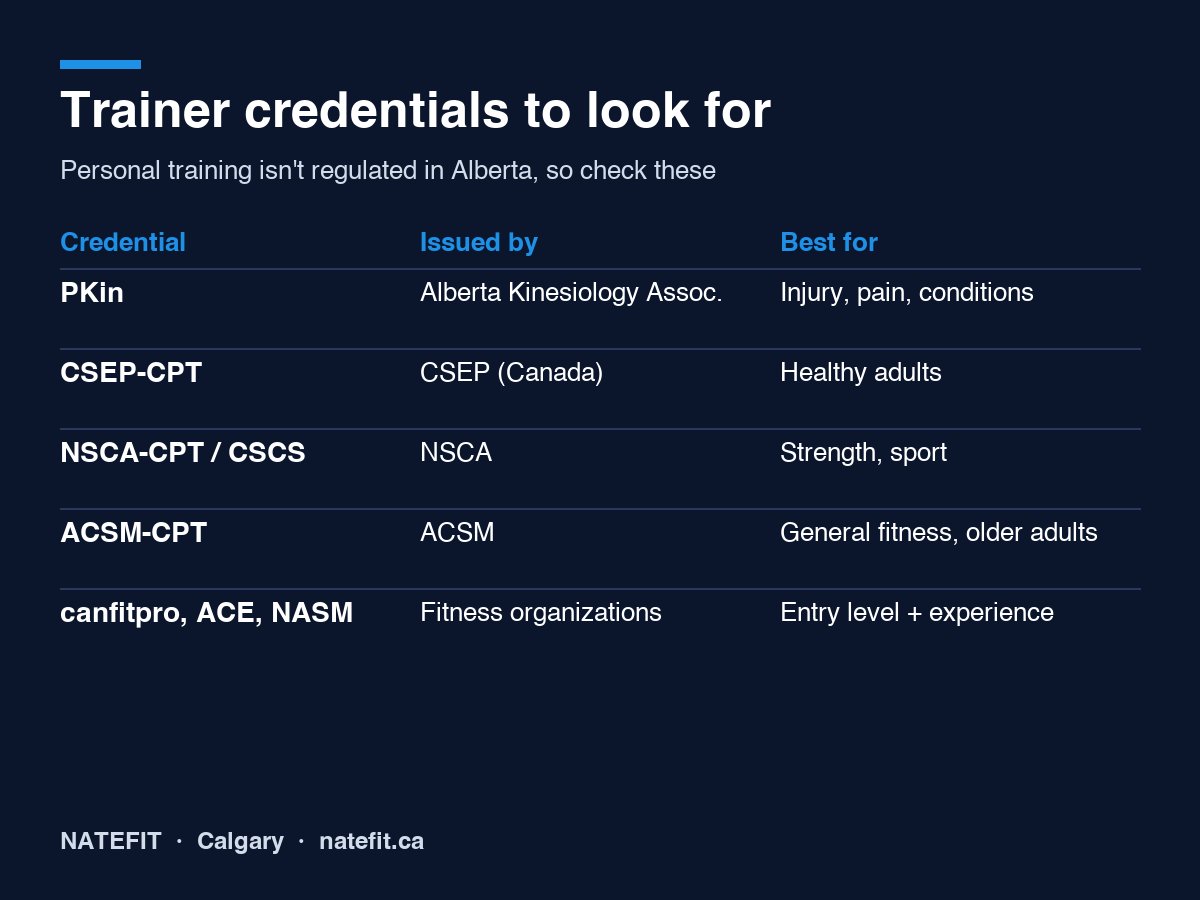
When you choose a personal trainer, look for a nationally recognized certification at minimum, and a kinesiology degree if you have an injury, pain or a health condition.
| Credential | Who gives it | What it takes | Good for |
|---|---|---|---|
| Professional Kinesiologist (PKin) | Alberta Kinesiology Association | Kinesiology or exercise science degree, 300 practical hours, liability insurance | Injuries, chronic pain, health conditions, insurance claims |
| CSEP-CPT | Canadian Society for Exercise Physiology | 2 years (60 credits) of post-secondary study in a related field, plus theory and practical exams | Healthy adults; strong Canadian standard |
| NSCA-CPT / CSCS | National Strength and Conditioning Association | Exam; age 18+, high school and CPR/AED (CSCS also needs a degree) | Strength and sport performance |
| ACSM-CPT | American College of Sports Medicine | Exam; age 18+, high school and CPR/AED | General fitness, older adults |
| canfitpro PTS, ACE, NASM | Canadian/US fitness organizations | Course and exam | Entry level; look for experience too |
A certificate shows someone passed an exam. It doesn’t show they can coach. Use it as the first filter, then use the questions below.
How to choose a personal trainer: 7 checks
These seven checks are how I’d choose a personal trainer for my own family.
- Credentials you can confirm. Ask which certification they hold and when it was renewed. A PKin can give you their AKA member number (mine is #2017-231).
- Experience with people like you. A great powerlifting coach isn’t automatically right for a 65-year-old with a knee replacement. Ask who they usually train.
- A real assessment first. A good trainer measures before they program: your goals, health history, injuries, how you move, and a starting point you can re-test.
- A written plan with a timeline. You should know what you’re working on for the next 8 to 12 weeks and how progress will be measured.
- Coaching, not counting. Watch a session or book a trial. A good trainer corrects your form, explains why, and adjusts when something hurts.
- Clear, written pricing. Prices, packages, cancellation policy and GST should be on the website or in writing before you buy.
- A good fit. You’ll spend hours with this person. You should feel listened to, not judged or rushed.
Questions to ask before you choose a personal trainer
Ask these before you choose a personal trainer and sign up. A good trainer will answer each one clearly in a sentence or two.
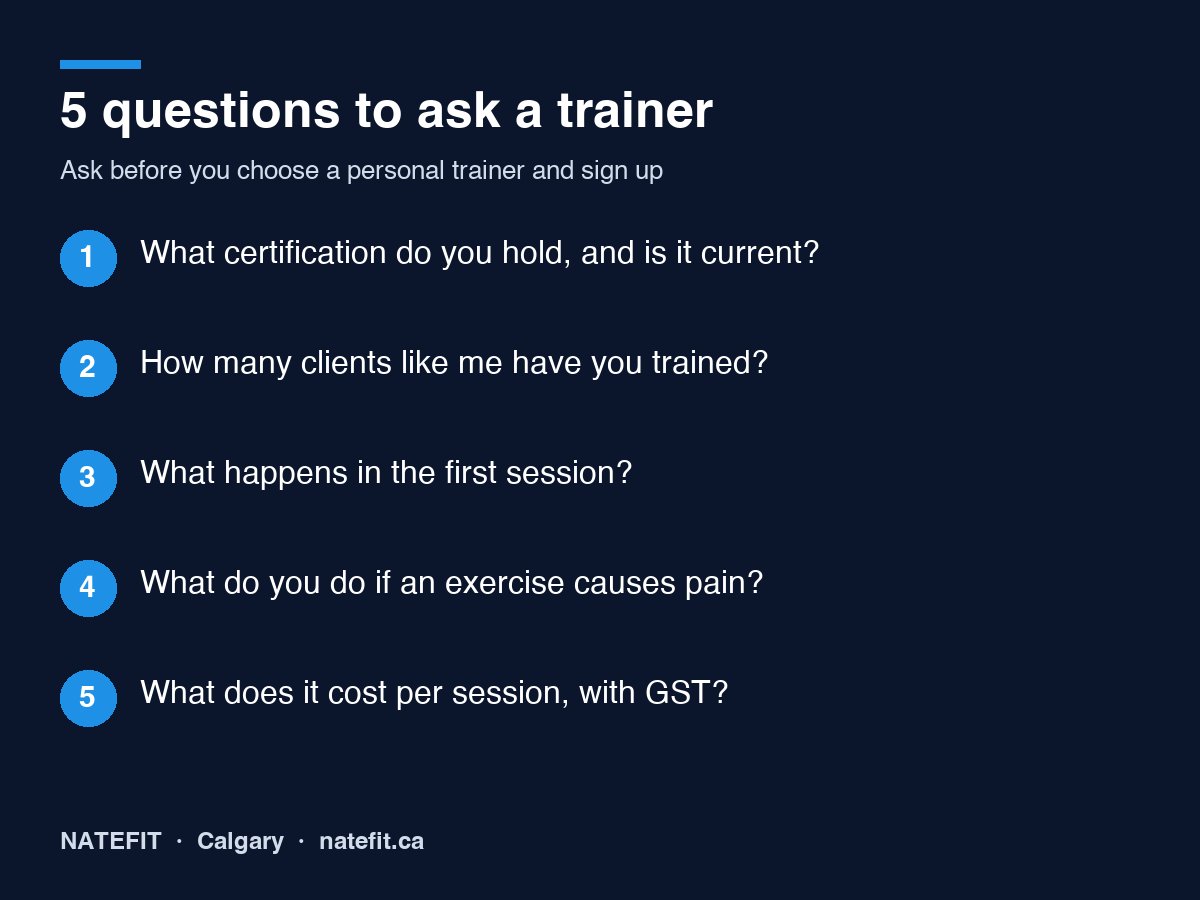
- What certification do you hold, and is it current?
- How many clients like me (my age, goal or injury) have you trained?
- What happens in the first session?
- How will we measure progress, and how often?
- What will a typical week of training look like, including what I do on my own?
- What do you do if an exercise causes pain?
- Do you work with physiotherapists or doctors when needed?
- What does it cost per session, with GST, and is there a commitment?
- What’s your cancellation policy?
- Can I talk to a current client or read your Google reviews?
My tip: most new clients ask about our qualifications. The question I wish more people asked is “What’s your approach?” Ask it before you choose a personal trainer: their approach, more than their certificate, decides whether they’ll be a good fit for you.
Red flags when choosing a personal trainer
Keep looking if you see any of these.
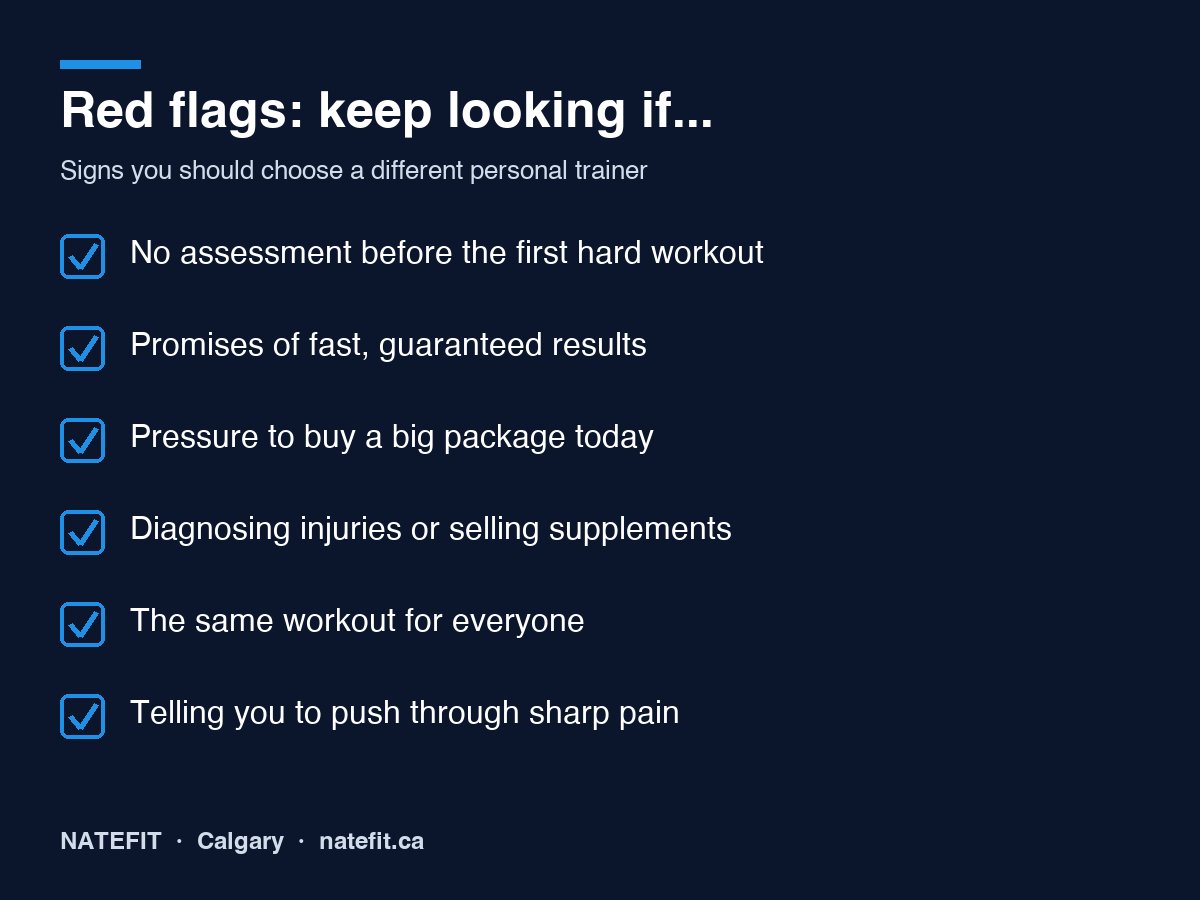
- No assessment. They start you on a hard workout in the first session without asking about injuries or health history.
- Promises of fast results. “Lose 30 pounds in 30 days” or a guaranteed number.
- Pressure to buy a big package today, especially with a deal that “ends tonight”.
- Diagnosing injuries or prescribing supplements. Trainers and kinesiologists don’t diagnose; that’s a doctor’s or physiotherapist’s job.
- Same workout for everyone. A copy-pasted program or a class disguised as one-on-one time.
- Phone out, attention elsewhere during your session.
- Pushing through pain. Discomfort from hard work is normal; sharp or worsening pain isn’t.
The red flag I hear about most from clients who come to us after another trainer: the trainer didn’t listen to what they actually needed, so the program wasn’t built for them. When you choose a personal trainer, notice whether they ask more than they talk in the first meeting.
Personal trainer vs kinesiologist: which one do you need?
Choose a kinesiologist if you have an injury, chronic pain or a health condition; choose a certified personal trainer if you’re healthy and want to get fitter.
A kinesiologist has a university degree in human movement and is trained to adapt exercise around pain, injury and conditions like arthritis or diabetes. In Alberta, many extended health plans also reimburse sessions with a Professional Kinesiologist. Our guide Is kinesiology covered by insurance in Alberta? explains how to check your plan.
A certified personal trainer is a great, lower-cost choice for healthy adults who want to get stronger, lose weight or stay consistent.
How much should a personal trainer cost in Calgary?
One-on-one personal training in Calgary usually costs about $70 to $130 a session. City of Calgary leisure centres sit at the low end (about $68 to $95 a session with GST, depending on the package); private studios and kinesiologists sit at the high end. Price matters when you choose a personal trainer, but it shouldn’t be the only test. Semi-private or small-group training costs less per session. Prices below about $50 for one-on-one time usually mean less experience; prices well above $150 should come with a clear reason.
Here’s what it looks like at NATEFIT (all prices plus GST):
- One-on-one with Cliff or Janine: $100 a session at 3 sessions a week, $105 at 2, $110 at 1, or $115 for a single session.
- One-on-one with Nathaniel (PKin): $120 a session.
- Semi-private training: $40 a session, in groups of up to 5.
- Getting started: a $125, 90-minute consultation that includes a Styku 3D body scan.
Example: two sessions a week with Cliff is 8 or 9 sessions a month, so about $840 to $945 plus GST. Swapping one of those for a semi-private session (one session a week with Cliff at $110, plus one at $40) brings it to roughly $600 to $675.
How to choose a personal trainer who fits your goal
Match the trainer’s experience to your main goal. It’s the simplest way to choose a personal trainer who can actually help you.
- Weight loss: someone who coaches habits and nutrition, not just workouts, and tracks body composition rather than only the scale.
- Strength: someone who teaches the main lifts (squat, deadlift, press) and writes progressive programs.
- Injury or chronic pain: a Professional Kinesiologist, ideally one who works alongside physiotherapists.
- Older adults: experience with balance, bone health and joint replacements (ACSM or Functional Aging training helps).
- Women’s strength and life stages: experience with pregnancy, postpartum and perimenopause training.
- An event (HYROX, a marathon): someone who has coached or done the event.
At NATEFIT, Cliff Krauss is a CSEP Certified Personal Trainer, Janine Bombenon is ACSM and NSCA certified with Functional Aging training, and I’m a Professional Kinesiologist. I match each new client to a coach based on two things: the coach’s experience with that goal, and whether I think their personalities will fit.
Frequently asked questions
How do I choose a personal trainer?
Check for a recognized certification or a Professional Kinesiologist designation, ask who they usually train, make sure they assess you before the first workout, and get prices and policies in writing. Then book one session to see if you get along.
How can you tell if a personal trainer is good?
A good trainer asks about your goals and health history, assesses how you move, explains why you’re doing each exercise, corrects your form, and tracks progress you can see. Good Google reviews from clients like you are a strong sign.
Do personal trainers need a licence in Alberta?
No. Personal training isn’t a regulated profession in Alberta, so certifications such as CSEP-CPT are voluntary. Ask which certification a trainer holds and whether it’s current.
Is a kinesiologist better than a personal trainer?
Not better, just different. A kinesiologist has a university degree and is trained to work around injuries and health conditions; a certified personal trainer is a good fit for healthy adults with fitness goals.
How many sessions a week should I book with a personal trainer?
Most people do well with 2 sessions a week, plus 1 or 2 workouts on their own. One session a week works if you’ll follow the plan between sessions; 3 is best when you want faster progress or need closer coaching.
Is $300 a month a lot for a personal trainer?
In Calgary, $300 a month usually buys 2 or 3 one-on-one sessions, or about 7 semi-private sessions at NATEFIT’s $40 rate. It’s a reasonable budget for semi-private training or one coached session a week with a plan to follow on your own.
Book a consultation
If you’re still deciding how to choose a personal trainer, start with a conversation. Read more about working with a personal trainer in Calgary at NATEFIT, or book a 90-minute consultation. We’ll assess how you move, scan your body composition, and match you with the coach who fits your goal.
About the author
Nathaniel Ernst is a Professional Kinesiologist with the Alberta Kinesiology Association (member #2017-231) and the founder of NATEFIT in southeast Calgary. He holds a B.Sc. in Exercise Science from the University of Lethbridge, is Precision Nutrition certified, and has coached clients for more than ten years.
This article is general information, not medical advice. If you have an injury or a health condition, talk to your doctor before starting a new exercise program.