


Short answer: Kinesiology isn’t covered by Alberta Health Care, but kinesiology insurance coverage is common in extended health plans. Coverage usually falls under “paramedical” or “practitioner” benefits, with a yearly dollar limit. Among our clients, that limit is usually $500 to $1,000 a year. Whether you’re covered depends on your specific plan, not just your insurer, so a five-minute check before your first session is worth it.
I’m Nathaniel Ernst, a Professional Kinesiologist (PKin) with the Alberta Kinesiology Association, and I train clients at NATEFIT in southeast Calgary. Almost every new client asks me about insurance. A lot of them are surprised to find out their plan covers kinesiology, often after they had assumed it didn’t. Here’s what I tell them.
In this guide:
- What Alberta Health Care covers (and doesn’t)
- Kinesiology insurance coverage by insurer
- What kinesiology insurance usually pays for
- How to check your plan in five minutes
- What your receipt needs to show
- How far does $500 to $1,000 of coverage go?
- Health spending accounts and wellness accounts
- How to submit a kinesiology insurance claim
- Tips to make your kinesiology insurance go further
- Frequently asked questions
- Book a session
What Alberta Health Care covers (and doesn’t)
The Alberta Health Care Insurance Plan pays for doctor visits and hospital care. It doesn’t pay for kinesiology, personal training or most exercise therapy. Any coverage comes from an extended health plan, usually through your employer, or from a private plan you buy yourself.
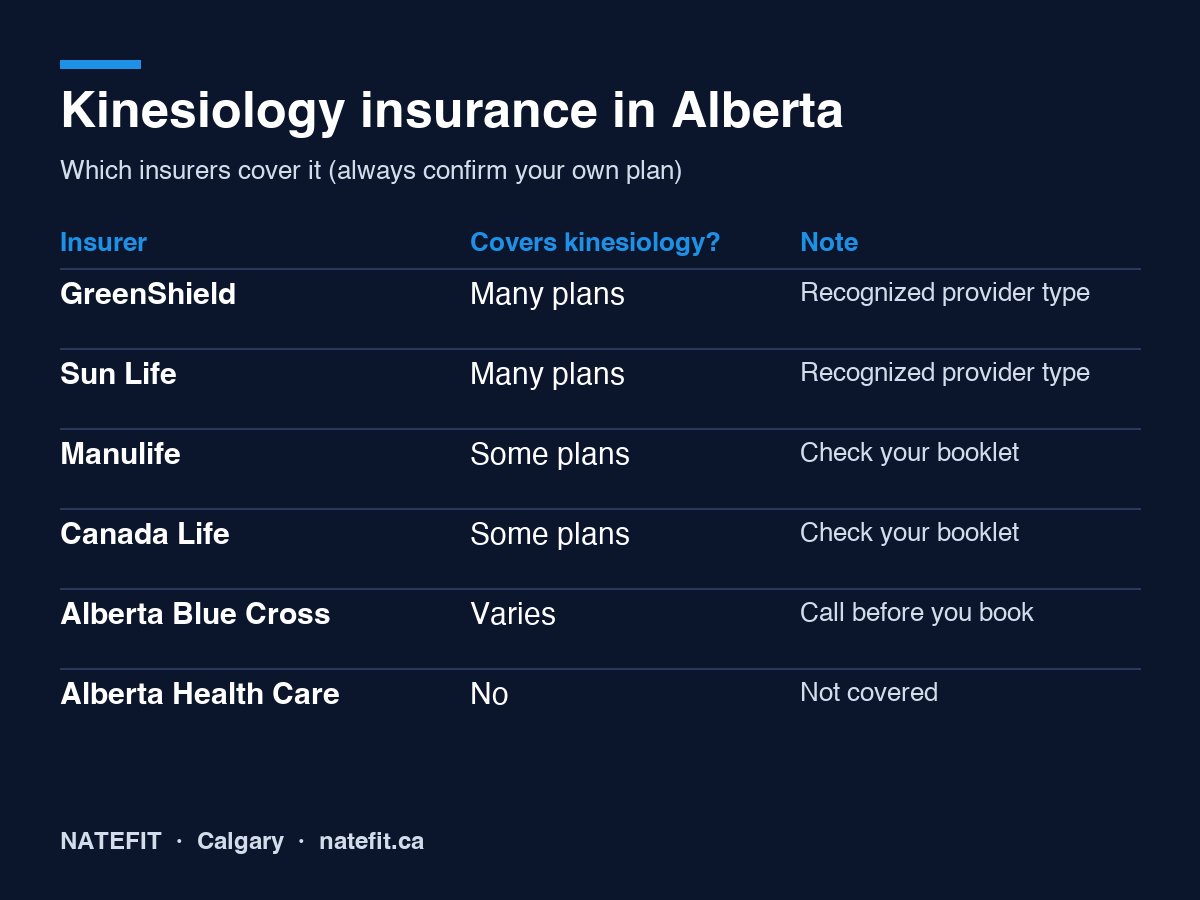
Kinesiology insurance coverage by insurer
Each insurer sells many plans, and each employer chooses what its plan includes. Use this as a guide, then confirm with your own plan.
| Insurer | Does it cover kinesiology? | Notes |
|---|---|---|
| GreenShield (incl. Empire Life, SSQ) | Many plans include it | Kinesiologists are a recognized provider type |
| Sun Life | Many plans include it | Kinesiologists are a recognized provider type |
| Manulife | Some plans include it | Check your plan booklet |
| Canada Life | Some plans include it | Check your plan booklet |
| Alberta Blue Cross | Varies by plan | Kinesiology isn’t a standard provider type with Alberta Blue Cross, so check your booklet or call 1-800-661-6995 before you book |
At NATEFIT, kinesiology isn’t direct-billed. You pay at the studio, then submit the claim to your insurer yourself. It takes about two minutes in most insurers’ apps.
What kinesiology insurance usually pays for
Most plans that include kinesiology reimburse one-on-one work with a registered or accredited kinesiologist. At NATEFIT, that means:
- Your initial kinesiology assessment (our 90-minute consultation)
- One-on-one kinesiology sessions with a Professional Kinesiologist
What kinesiology insurance usually doesn’t cover: gym memberships, group classes, sessions with a personal trainer who isn’t a kinesiologist, and supplements or equipment. Some plans also cap how much they’ll pay per visit, so check the fine print.
How to check your plan in five minutes
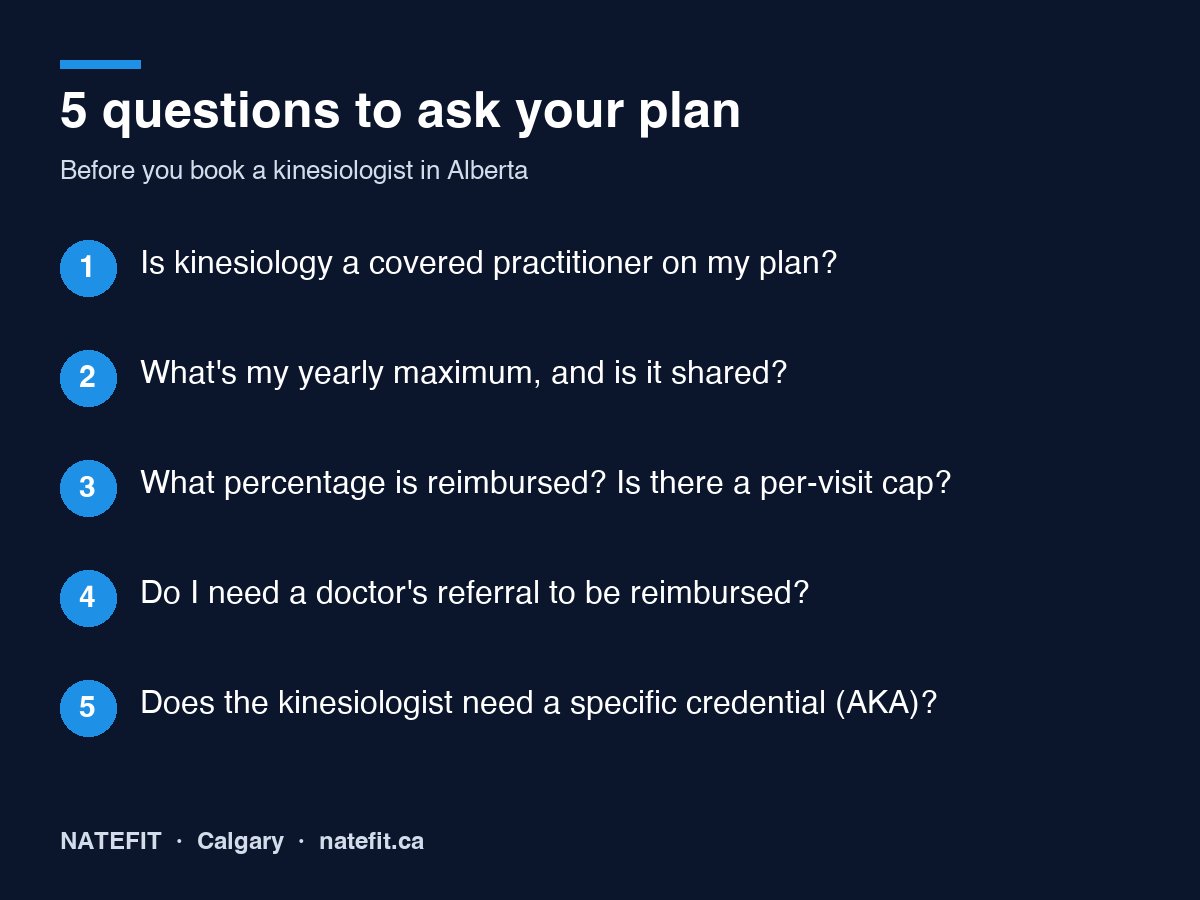
To check your kinesiology insurance, log in to your insurer’s app or member site, or call the number on your benefits card, and ask:
- Is kinesiology a covered practitioner on my plan? Sometimes it’s listed by name. Sometimes it’s grouped with massage, physio or chiropractic.
- What’s my yearly maximum, and is it shared? Many plans give one combined amount for several practitioners. If you’ve used it on massage, there may be less left.
- What percentage is reimbursed, and is there a per-visit cap?
- Do I need a doctor’s referral? You don’t need one to book with a kinesiologist, but some plans ask for one before they’ll pay.
- Does the kinesiologist need a specific credential? Most plans ask for a registered or accredited kinesiologist. In Alberta, that means membership in the Alberta Kinesiology Association (AKA).
What your receipt needs to show
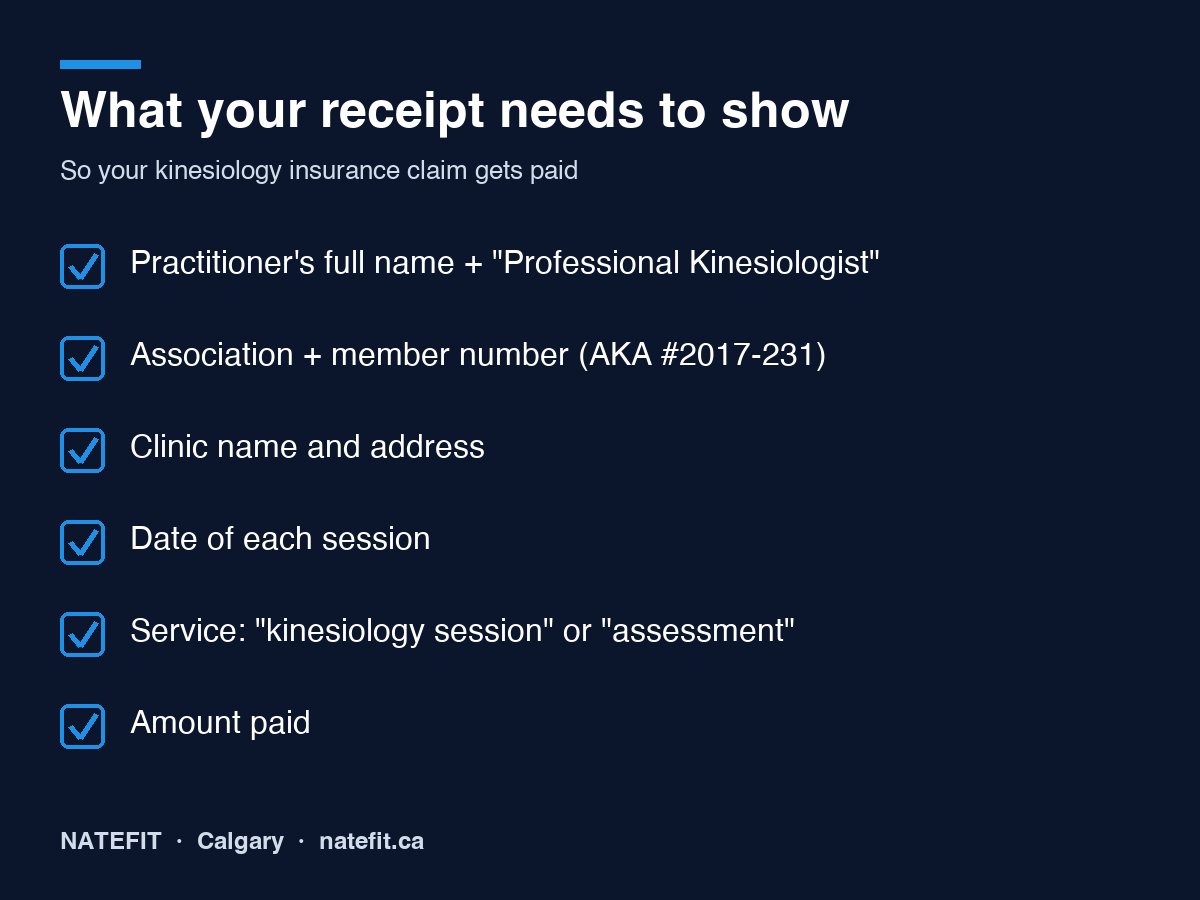
Most denied kinesiology insurance claims are missing a detail on the receipt. A kinesiology receipt should show:
- The practitioner’s full name and “Professional Kinesiologist”
- The association and member number (for me: Alberta Kinesiology Association, #2017-231)
- The clinic name and address
- The date of each session
- The service (“kinesiology session” or “kinesiology assessment”, not just “training”)
- The amount paid
You get a receipt automatically after every session. If you’re claiming kinesiology, just ask, and I’ll send you a kinesiology receipt with my AKA member number on it.
At NATEFIT, sessions with me are $120 per 60-minute session plus GST. New clients start with a 90-minute consultation ($125 plus GST) that includes a Styku 3D body scan. The consultation can be receipted as a kinesiology assessment, so it’s usually claimable too.
One honest note: only sessions delivered by a Professional Kinesiologist can be receipted as kinesiology. Sessions with our certified personal trainers are personal training, and extended health plans usually don’t cover that. (See the next section for one exception.)
How far does $500 to $1,000 of coverage go?
Here’s what that looks like at our prices. A kinesiology session at NATEFIT is $120 plus GST ($126.00). The 90-minute consultation is $125 plus GST ($131.25).
- Plan pays 100%, $500 a year: the consultation plus 2 sessions ($383.25), with $116.75 left toward a third.
- Plan pays 80%, $750 a year: you get $100.80 back per session, so your maximum covers about 7 sessions.
- Plan pays 100%, $1,000 a year: the consultation plus 6 sessions ($887.25), with $112.75 left.
Many clients use their kinesiology insurance for an assessment and a block of sessions to learn their program, then keep training on their own or in a small group.
Health spending accounts and wellness accounts
Some employers offer an extra account on top of the regular benefits:
- Health spending account (HSA): an HSA can only pay for expenses that qualify for the federal medical expense tax credit. Kinesiologists aren’t on CRA’s list of authorized medical practitioners for Alberta, so kinesiology usually can’t be paid from an HSA here.
- Lifestyle or wellness spending account (LSA/WSA): these often cover fitness costs like gym memberships and personal training. If you have one, it may cover sessions with any of our trainers, not just me. Check your plan’s list of eligible expenses.
How to submit a kinesiology insurance claim
- Check your coverage using the five questions above.
- Book your session and pay at the studio.
- Ask for a kinesiology receipt with my AKA member number.
- Submit the claim in your insurer’s app or member site. Most let you upload a photo of the receipt.
- Your insurer pays you back, usually by direct deposit.
Tips to make your kinesiology insurance go further
- Check when your benefit year resets. Some plans reset on January 1, others on your plan’s anniversary date. Unused coverage usually doesn’t carry over.
- Use your spouse’s or partner’s plan too. If you’re also covered under their plan, you can often claim the part yours didn’t pay. This is called coordination of benefits.
- Plan around shared maximums. If kinesiology shares a limit with massage or physio, decide how you’ll split it across the year.
- Ask for your plan booklet. If the app is unclear, your HR team or plan administrator can send the full benefits booklet. It lists every covered practitioner, each yearly limit and any referral rules.
- Submit claims soon after each session. Most plans set a deadline for claims, and it’s easy to lose track of receipts.
Frequently asked questions
Do I need a referral to see a kinesiologist in Alberta?
No. You can book directly. Some insurance plans ask for a doctor’s note before they reimburse, so check your plan.
Does kinesiology insurance cover the first assessment?
Often, yes. At NATEFIT the 90-minute consultation can be receipted as a kinesiology assessment, so most plans that cover kinesiology will reimburse it.
How much kinesiology coverage do most plans have?
It varies. Most of our clients have between $500 and $1,000 a year. Some plans share that amount with other practitioners like massage or physio.
Is kinesiology the same as physiotherapy for insurance?
No. They’re usually separate items, each with its own limit, though some plans group them under one combined amount.
Do you direct-bill insurance?
No. You pay at the studio and submit the claim yourself. We’ll give you a receipt with everything your insurer needs.
Can I claim personal training on my health benefits?
Usually not under extended health. A lifestyle or wellness spending account often covers it.
Can I claim kinesiology on my taxes in Alberta?
Generally no. Kinesiologists aren’t on CRA’s list of authorized medical practitioners for Alberta, so kinesiology usually doesn’t qualify for the medical expense tax credit. The one place it is on that list is Ontario.
Book a session
If your plan includes kinesiology insurance coverage, it can pay for a big part of your training. Read more about kinesiology sessions with Nathaniel, or book a consultation and bring your plan details. We’ll make sure your receipts have everything your kinesiology insurance claim needs.
About the author
Nathaniel Ernst is a Professional Kinesiologist with the Alberta Kinesiology Association (member #2017-231) and the founder of NATEFIT in southeast Calgary. He holds a B.Sc. in Exercise Science from the University of Lethbridge, is Precision Nutrition certified, and has coached clients for more than ten years.
This article is general information, not advice about your specific plan or taxes. Always confirm coverage with your insurer.