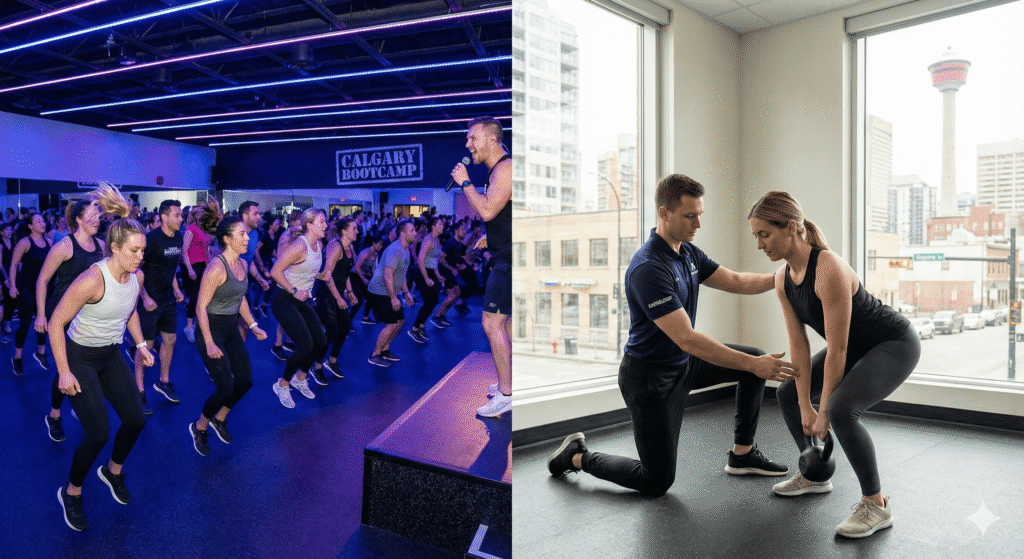
Group Classes vs. Personal Training? You’ve finally decided to commit to your health. You’re ready to put in the work, but now you face the classic dilemma: do you sign up for that high-energy bootcamp your coworker raves about, or do you invest in a private coach who watches your every move?
Bottom Line Up Front (BLUF): If your primary goal is general fitness, social motivation, and keeping costs low, Group Classes are your best bet. However, if you have specific goals (injury rehab, significant weight loss, sport-specific performance) or need high accountability to stay consistent, Personal Training offers a superior return on investment (ROI) despite the higher upfront cost.
In this post, we’ll analyze the efficacy, cost, and “real world” results of both options to help you decide where to allocate your budget.
The fundamental difference isn’t just the price tag; it’s the philosophy of training.
Group fitness relies on the energy of the crowd. Whether it’s HIIT, spin, or circuit training, the workout is pre-programmed for the “average” participant.
Private coaching is engineering for your body. It starts with an assessment of your unique biomechanics, history, and goals.
Expert Note: In my experience as a kinesiologist, I often see clients switch to personal training after getting injured in a high-intensity group class because they lacked the foundational movement patterns to keep up with the pace safely.
When it comes to pure efficacy—getting from Point A to Point B—science leans heavily in one direction.
A study published in the Journal of Sports Science & Medicine found that individuals working with a personal trainer saw significantly greater improvements in lean body mass and chest press strength compared to those training alone or in groups without direct supervision.
Why? Progressive Overload.
In a group class, you often grab the same 20lb dumbbells week after week. In private coaching, your trainer explicitly tracks your lifts and ensures you are increasing volume or intensity every single session.
The Verdict:
This is usually the deciding factor for most people. Let’s break down the numbers for the Calgary market.
| Feature | Group Fitness / Bootcamps | Private Personal Training |
| Avg. Cost Per Session | $20 – $35 | $80 – $130 |
| Monthly Cost (3x/week) | ~$250 – $400 | ~$960 – $1,500 |
| Hidden Costs | Membership fees, “Drop-in” premiums | None (usually inclusive) |
| Value Add | Community, shower amenities | Nutrition coaching, body scans, 24/7 support |
Sticker shock is real. However, consider the Cost of Inaction.
If you pay $250/month for a bootcamp but stop going after 3 months because you aren’t seeing changes or your back hurts, you’ve wasted $750.
If you pay $1,000 for one month of PT, learn proper form, get a nutrition plan, and build a habit that lasts a lifetime, the value is infinite.
Tip: Many Calgary trainers (including us at NateFit) offer “hybrid” or small group options that bridge this gap, offering coaching for closer to $40-$60/session.
We’ve all been there: it’s 6:00 PM, it’s -20°C outside in Calgary, and your couch looks inviting.
The Psychology of Investment
When you pay a premium for a service, you are psychologically more likely to utilize it. This is known as the “Sunk Cost Effect” in behavioral economics. My clients often tell me, “I didn’t want to come, but I knew you had the workout written for me.”
Common Mistake: Relying on a “cancellation fee” as your only motivation. True accountability comes from a relationship with a coach who cares about your progress, not just your payment.
This is the most overlooked factor in the “Group classes vs personal training” debate.
In a bootcamp of 25 people, the instructor cannot watch everyone’s knees during a squat. They are focused on pacing and energy. If you have a desk job and tight hips, doing 50 rapid-fire jump squats is a recipe for a torn meniscus or lower back strain.
Private Coaching mitigates this by:
Deciding isn’t about which is “better” objectively, but which fits your current lifestyle phase.
The “Hybrid” Approach
Can’t decide? Many successful clients start with 3 months of Private Coaching to learn proper technique and build a base, then transition to group classes once they are confident and safe.
1. Can I lose weight faster with a personal trainer?
Generally, yes. While you burn calories in group classes, a personal trainer (especially one with a kinesiology background) will manage your nutrition and NEAT (Non-Exercise Activity Thermogenesis), which accounts for 80% of weight loss success.
2. Are bootcamps bad for beginners?
Not inherently, but they can be risky. If you don’t know how to hinge at the hips or engage your core, high-intensity classes can reinforce bad movement patterns. We recommend at least 3-5 private sessions to learn the ropes before joining a bootcamp.
3. How often should I see a personal trainer?
For best results, 2-3 times per week is the “sweet spot.” However, even 1 session per week (with homework workouts done on your own) is superior to 5 random group classes with poor form.
4. Is small group training a good middle ground?
Yes! Small group training (2-4 people) offers the customization of PT at a price point closer to bootcamps. It’s a growing trend in Calgary for a reason.
Allocating your fitness budget is an investment in your future self. While group classes offer a fantastic community and a great sweat, they often lack the specificity required to change your body composition or fix chronic pain.
If you are tired of guessing what to do in the gym, or if you’ve been spinning your wheels in generic classes without seeing the mirror change, it might be time to hire a professional.
Ready to stop guessing and start transforming?
At NateFit, we specialize in bridging the gap between rehab and high performance. We don’t just count reps; we engineer a lifestyle you can sustain.
Click here to book your Consultation & Body Scan at NateFit today.
About the Author
Nathaniel Ernst is a Professional Kinesiologist and Certified Personal Trainer with over 10 years of experience coaching clients in the Calgary area. He specializes in strength training, injury rehab, and mobility for athletes and busy professionals.